Module 43: System Design — Distributed Job & Task Scheduler
Comprehensive architectural breakdown of a large-scale Distributed Job & Task Scheduler (Google Chronos, Netflix Conductor, Quartz, Celery), covering distributed cron coordination, delayed execution engines (Hashed Time Wheels & Redis ZSETs), worker failure failover, and idempotent task execution.
Prerequisites
Before tackling distributed job schedulers, review these core modules:
- 15 - Consensus & Leader Election (Raft, leader coordination, split-brain avoidance)
- 17 - Message Queues & Streaming (Delayed queues, dead-letter queues, worker groups)
- 20 - Fault Tolerance & Resilience (Heartbeats, failure detection, exponential retry)
- 32 - REST API Design & Idempotency (Idempotent task execution)
ELI5 (30-Second Summary)
Imagine a giant hospital where 1,000 nurses need to administer medicine to 50,000 patients at exact times: "Patient #42 needs insulin at 2:00 PM; Patient #99 needs antibiotics every 6 hours".
If every nurse maintained their own personal paper notebook, two nurses might give Patient #42 two doses of insulin (Double Execution), or if a nurse gets sick and faints in the hallway, their patients would receive no medicine at all (Dropped Tasks)!
A Distributed Job Scheduler uses a single Chief Coordinator (with backup coordinators elected via Raft) that places all medicine tasks on a giant automated conveyor belt (Time Wheel / Priority Queue). When a task's clock strikes, the coordinator dispatches it to an available nurse. If that nurse doesn't send a radio "I'm alive" ping (Heartbeat) within 30 seconds, the task is immediately reassigned to another nurse!
Physical Analogy
Think of a Mechanical Grandfather Clock with an Automated Factory Dispatch Chute:
| Factory Analogy | Job Scheduler Concept | Technical Description |
|---|---|---|
| Rotating Clock Gear (60 Second Tick) | Hashed Timing Wheel / Tick Loop | Constant-time O(1) timer wheel advancing execution pointers. |
| Scheduled Work Order Envelope | Job Metadata Record | Defines payload, trigger timestamp, recurrence interval, and execution timeout. |
| Factory Shift Foreman | Scheduler Leader / Coordinator | Node holding master lock via etcd/ZooKeeper, dispatching tasks. |
| Factory Assembly Line Workers | Worker Nodes (Execution Fleet) | Stateless compute instances executing containerized jobs. |
| Worker Clocking in every 10 seconds | Worker Heartbeat Ping | Ephemeral lease key confirming worker health and processing progress. |
| Foreman re-assigning task if worker vanishes | Automatic Task Re-Queueing | Detects missing heartbeats and re-dispatches tasks to healthy nodes. |
The Problem It Solves
Single-server cron daemons (crontab) fail at enterprise scale due to critical limitations:
- Single Point of Failure (SPOF): If the cron machine crashes, power fails, or its disk corrupts, all corporate scheduled workflows stop executing.
- Resource Exhaustion: Running 500 heavy machine learning or database backup jobs simultaneously on one machine spikes CPU/memory to 100%, causing out-of-memory kernel kills.
- No Execution History or Retries: Traditional cron drops failed tasks silently with zero automated retry logic, exponential backoff, or distributed logging.
Visual Architecture
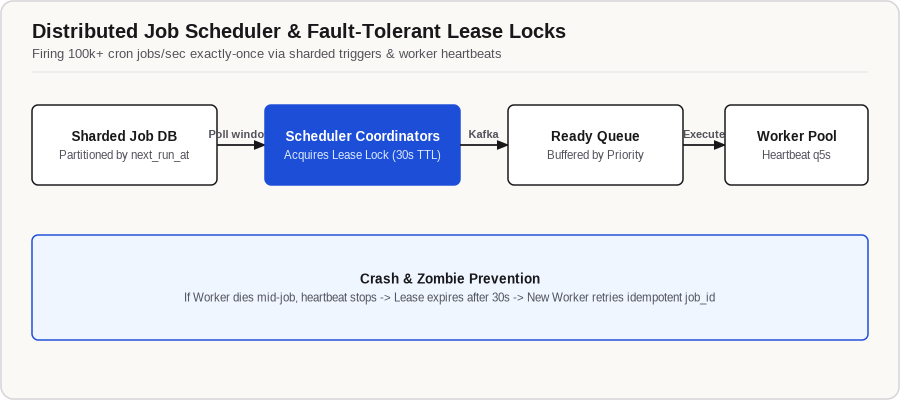
flowchart TD
    subgraph ControlPlane["1. Scheduler Coordination Plane (High Availability)"]
        Leader["Scheduler Leader (Elected via Raft/Etcd)"]
        Follower["Scheduler Standby Replica"]
        Etcd[("Etcd / ZooKeeper (Distributed Lock & Leader Lease)")]
        Leader <-->|"Heartbeat Lease (TTL 5s)"| Etcd
        Follower -.->|"Watch Lease"| Etcd
    end

    subgraph Storage["2. Job Storage & Delayed Queue"]
        JobDB[("Job Metadata Database (PostgreSQL / Spanner)")]
        TimeWheel[("Delayed Execution Engine (Redis ZSET / Kafka Wheel)")]
        Leader -->|"Poll Due Jobs (ts <= NOW)"| TimeWheel
        Leader <--> JobDB
    end

    subgraph Workers["3. Distributed Worker Fleet"]
        TaskQ["Dispatch Message Queue (RabbitMQ / SQS)"]
        Leader -->|"Push Executable Task"| TaskQ

        TaskQ --> Worker1["Worker Node A"]
        TaskQ --> Worker2["Worker Node B"]
        TaskQ --> Worker3["Worker Node C"]

        Worker1 -->|"Send Heartbeat & Result"| Leader
        Worker2 -->|"Send Heartbeat & Result"| Leader
    end
Real Numbers & Concurrency Sizing
Consider a scheduler managing 100 Million Jobs Daily (e.g., Uber trip receipts, payment retries, daily summaries):
- Throughput Sizing:
- 100M / 86,400 ≈ 1,160 jobs scheduled & executed/second.
- Peak dispatch bursts (e.g., Top of the Hour at midnight): 25,000 jobs/second.
- Job Record Sizing:
- Average job record: Job ID (8 bytes) + Next Run Timestamp (8 bytes) + Recurrence Cron (16 bytes) + Target Handler URI (64 bytes) + Payload JSON (500 bytes) ≈ 600 bytes.
- Active scheduled jobs (10 million in queue): 10M × 600 bytes ≈ 6.0 Gigabytes.
- Redis Sorted Set Memory:
- Store scheduled execution timestamps as scores:
ZADD delayed_jobs <timestamp_ms> <job_id>. - 10 million entries in Redis ZSET: 10M × 64 bytes ≈ 640 Megabytes of RAM!
- Redis can query and pop due jobs (
ZRANGEBYSCORE delayed_jobs 0 <now_ms>) in sub-millisecond execution times.
- Store scheduled execution timestamps as scores:
Deep Dive: Under the Hood
1. Timing Mechanics: Redis ZSET vs. Hashed Timing Wheel
- Redis Sorted Set Approach:
- Score = UTC execution timestamp in milliseconds.
- Schedulers execute
ZRANGEBYSCORE delayed_jobs 0 <current_time_ms> LIMIT 0 100every 100ms. - Atomic pop is achieved via Redis 6.2+
ZPOPMINor Lua scripts.
- Hierarchical Hashed Timing Wheel (George Varghese & Tony Lauck Algorithm):
- An array of circular buckets representing time units (e.g., a 60-slot second wheel, a 60-slot minute wheel, a 24-slot hour wheel).
- A tick pointer advances every second (O(1) time complexity).
- When the pointer lands on slot 14, all tasks attached to slot 14's linked list are executed immediately!
- Incurs zero sort overhead (O(1) insertion and O(1) retrieval).
2. Leader Election & High Availability
To prevent two scheduler nodes from executing the same cron job simultaneously:
- Schedulers compete for a distributed lock lease in etcd:
PUT /scheduler/leader node_1 LEASE 10s. - Only the node holding the active lease runs the polling loop.
- The leader refreshes its lease every 3 seconds.
- If the leader crashes, etcd's lease expires after 10 seconds; standby followers detect the deletion and elect a new leader automatically.
3. Worker Heartbeating & Resiliency
- When Worker A pulls a task, the task status transitions to
RUNNINGwith an expiration deadline:deadline = NOW() + 30s. - While processing, Worker A sends periodic heartbeats every 10 seconds:
heartbeat(task_id) -> updates deadline = NOW() + 30s. - If Worker A experiences an out-of-memory crash or network split, the heartbeat stops.
- The Scheduler Leader detects that
NOW() > deadline, transitions the task back toSCHEDULED, and re-dispatches it to Worker B.
Trade-offs & Decision Matrix
| Dimension | Standalone Linux Cron | Redis ZSET Delayed Queue | Hierarchical Timing Wheel (In-Memory) |
|---|---|---|---|
| Scalability | Single machine only | Scales to millions of jobs | Scales to tens of millions of jobs |
| Retrieval Complexity | O(N) scan of crontab | O(\log N + M) sorted set range | Constant O(1) circular bucket tick |
| Fault Tolerance | Zero (SPOF) | High (Redis replication / AOF) | Requires external persistence checkpoint |
| Delayed Precision | 1 Minute | 1 Millisecond | 1 Millisecond / 1 Tick |
Common Pitfalls & Anti-Patterns
- Non-Idempotent Tasks: Assuming a job will only ever execute once. In distributed networks, worker timeouts and network retries guarantee at-least-once execution. If a charge job isn't protected by an
Idempotency-Key, retry recovery will charge customers twice! Rule: All scheduled job handlers must be idempotent. - Top-of-the-Hour Thundering Herd: Every developer schedules batch jobs for
00:00:00(midnight). At 12:00:00 AM, thousands of heavy jobs hit the worker pool simultaneously, exhausting CPU. Rule: Introduce random jitter (e.g.00:00:00+ random offset between 0-300 seconds) to smooth load spikes. - Database Polling Storms: 50 scheduler pods polling PostgreSQL
SELECT * FROM jobs WHERE run_at <= NOW()every 500ms will saturate database connection pools and cause CPU lockups.
Try It Yourself
A runnable, zero-dependency Python simulation demonstrating a distributed task scheduler with priority delay queue, multi-worker pool, heartbeating, and automatic worker failure recovery is included in this directory.
Run the simulation:
python demo.py
Production References & Further Reading
- Alex Xu: System Design Interview Vol 2 - Chapter 6 (Distributed Job Scheduler)
- George Varghese and Tony Lauck: Hashed and Hierarchical Timing Wheels (ACM TOCS, 1997)
- Netflix TechBlog: Meson - A Flexible System for Managing Large-Scale Machine Learning Pipelines
Top 5 Interview Questions with Model Answers
Q1: How do you guarantee that a scheduled job runs at most once versus at least once?
Model Answer: In distributed systems with node crashes and network partitions, mathematically guaranteed "exactly-once execution" is impossible. We achieve effective exactly-once semantics by combining At-Least-Once Dispatch with Idempotent Execution:
- The scheduler dispatches the task with a unique
job_execution_id. - The worker executing the job uses an atomic database lock or Redis idempotency check (
SETNX job_exec_id "LOCKED"). - If a network blip causes the scheduler to re-dispatch the job to a second worker, the second worker recognizes the execution ID and returns immediately without repeating side-effects.
Q2: How does a Hashed Timing Wheel achieve O(1) time complexity for scheduling delayed tasks?
Model Answer: A Timing Wheel is a circular buffer of N slots, where each slot represents a unit of time (e.g., 1 second). A hardware or software timer increments a circular pointer every tick (tick = (tick + 1) % N).
- When a job is scheduled for T seconds in the future, its target slot is calculated in O(1) time: slot = (current_tick + T) ±od N.
- The job is appended to the linked list at that slot in O(1) time.
- On every tick, the scheduler executes all tasks in the current slot linked list without scanning or sorting the remaining millions of tasks, achieving strictly O(1) amortized insertion and retrieval.
Q3: What happens when the active Scheduler Leader crashes while jobs are executing?
Model Answer:
- Leader Failover: Standby scheduler replicas monitor the leader's lease in etcd. When the lease expires (e.g., after 5-10 seconds), the standby nodes initiate leader election via Raft/etcd; the winner becomes the new active leader.
- State Reconciliation: The new leader inspects the persistent database/Redis store for tasks marked as
RUNNING. - Heartbeat Evaluation: The new leader checks the
last_heartbeat_timestampof all in-flight jobs. If a task's heartbeat has expired, the new leader marks it asFAILEDor re-queues it for retry.
Q4: How do you prevent "Thundering Herd" spikes when thousands of jobs are scheduled for midnight?
Model Answer:
- Automated Schedule Jitter: When a cron expression specifies midnight (
0 0 * * *), the scheduling engine automatically adds a deterministic pseudorandom jitter offset: offset = hash(job_id) ±od{300 seconds}. - Backpressure Rate Limiting: The scheduler dispatches tasks through a token-bucket rate limiter that caps dispatch velocity to match worker pool concurrency capacity.
- Priority Queue Separation: High-priority real-time business jobs (e.g., billing transfers) are placed in isolated queues so low-priority analytical reports cannot starve critical workflows.
Q5: How do you scale the scheduler when handling millions of delayed events spanning days or weeks?
Model Answer: A two-tier tiered storage architecture:
- Long-Term Tier (Cold Storage): Jobs scheduled days or weeks in the future are stored in a distributed relational database (PostgreSQL/Spanner) indexed by
run_at. - Short-Term Tier (Hot Memory / Redis / Time Wheel): An asynchronous pre-fetch daemon queries the database in batches every 10 minutes for jobs due in the next 15-minute window (
run_at BETWEEN NOW() AND NOW() + INTERVAL '15 minutes'), loading them into the in-memory Time Wheel / Redis ZSET for high-precision, sub-millisecond execution.
Check Yourself Quiz
1. What is the primary role of etcd or ZooKeeper in a distributed job scheduler architecture?
A) To execute Python scripts.B) To manage distributed leader election leases and ensure only one active scheduler leader dispatches tasks.
C) To store multi-gigabyte video files.
D) To format HTML emails.
Answer: B. Distributed lock leases prevent split-brain dual-leader scenarios.
2. What is the retrieval time complexity of a Hashed Timing Wheel on each tick?
A) O(N log N)B) O(N) where N is all future tasks
C) O(1) constant time to inspect the current circular bucket slot
D) O(2^N)
Answer: C. Advancing the circular pointer directly retrieves the bucket's linked list in constant time.
3. How does the scheduler detect that a worker node has crashed mid-task?
A) By phoning the worker's engineer.B) By monitoring worker heartbeats; if heartbeat stops and deadline expires, the task is marked failed and re-queued.
C) By restarting the entire cloud cluster.
D) By deleting the database.
Answer: B. Heartbeat timeouts detect crashed or partitioned workers automatically.
4. Why is schedule jitter necessary for cron jobs scheduled at the top of the hour?
A) To make clocks run faster.B) To smooth out execution spikes and prevent the thundering herd problem from overwhelming workers at 00:00.
C) To encrypt the cron expression.
D) Because Linux does not support midnight.
Answer: B. Spreading execution over a small window prevents resource exhaustion.
5. How can scheduled tasks achieve "effective exactly-once execution"?
A) By disabling retries.B) By combining at-least-once queue dispatch with idempotent task execution handlers.
C) By using single-threaded CPUs.
D) By running tasks only on weekends.
Answer: B. Idempotency guarantees that duplicate dispatches produce identical safe state.