Module 45: System Design — Ad Click Aggregation & Event Analytics
Comprehensive architectural breakdown of a Real-Time Ad Click Aggregation and Analytics System (Google Ads, Meta Ads, TikTok), covering stream processing (Flink/Spark), windowing strategies (Tumbling, Hopping, Sliding), Watermark heuristics for late-arriving events, and click-fraud deduplication.
Prerequisites
Before tackling ad click aggregation, review these core modules:
- 17 - Message Queues & Event Streaming (Kafka topics, consumer groups, partitions)
- 27 - Back-of-the-Envelope Estimation (Calculating click throughput and aggregation storage)
- 31 - Time, Clocks & Ordering (Event time vs Processing time vs Ingestion time)
- 32 - REST API Design & Idempotency (Idempotent tracking endpoints)
ELI5 (30-Second Summary)
Imagine a busy highway with 1 billion cars driving past billboard ads every day. Every time a driver looks at an ad or visits a store, a penny is transferred from the advertiser to the billboard owner.
If your accounting system counted every single click on a separate piece of paper and billed advertisers one by one, your computers would melt under the paperwork. Even worse: what if a mischievous competitor writes a bot that clicks your billboard 10,000 times in 10 seconds (Click Fraud)? Or what if a driver drives through a mountain tunnel with no cell service, and their click arrives 15 minutes late (Late-Arriving Events)?
An Ad Click Aggregation System groups clicks into tidy 1-minute buckets (Tumbling Windows), filters out robotic duplicate clicks, and uses an intelligent clock (Watermarks) to count late-arriving clicks accurately so advertisers are billed fairly to the exact penny!
Physical Analogy
Think of a Rain Gauge Measuring Rainfall During a Storm:
| Rain Gauge Analogy | Ad Click Aggregation Concept | Technical Description |
|---|---|---|
| Individual Raindrops Falling | Raw Ad Click Events | High-velocity click streams ingested into Apache Kafka. |
| Marked 1-Minute Measurement Beaker | Tumbling Window (1-Minute) | Non-overlapping fixed time window aggregating metric counts. |
| Water Splashing from Shaken Trees (Delayed Drops) | Late-Arriving Events (Watermark Lag) | Events delayed by mobile cell handoffs or airplane offline modes. |
| Mesh Filter Straining Leaves and Debris | Click Fraud & Bot Filter (Bloom Filter) | Identifies duplicate or robotic clicks from the same IP/Device. |
| Logging Total Inches in the Farm Logbook | Analytical OLAP DB (ClickHouse / Druid) | Stores summarized aggregation tables for real-time advertiser dashboards. |
The Problem It Solves
Digital advertising engines (Google Search Ads, Instagram Sponsored Posts) power multi-billion dollar ecosystems:
- Financial Integrity: Advertisers pay real money per click (Cost-Per-Click: CPC). Over-counting due to network retries causes advertiser lawsuits; under-counting loses revenue.
- Massive Scale: Platforms process 10 billion ad impressions and 1 billion clicks daily (> 50,000 clicks/second peak).
- Event Time vs. Processing Time Discrepancies: A user clicks an ad at
14:00:00on a subway train; their phone loses signal and delivers the click payload at14:12:30. The system must attribute the click to the14:00:00window for accurate analytics.
Visual Architecture
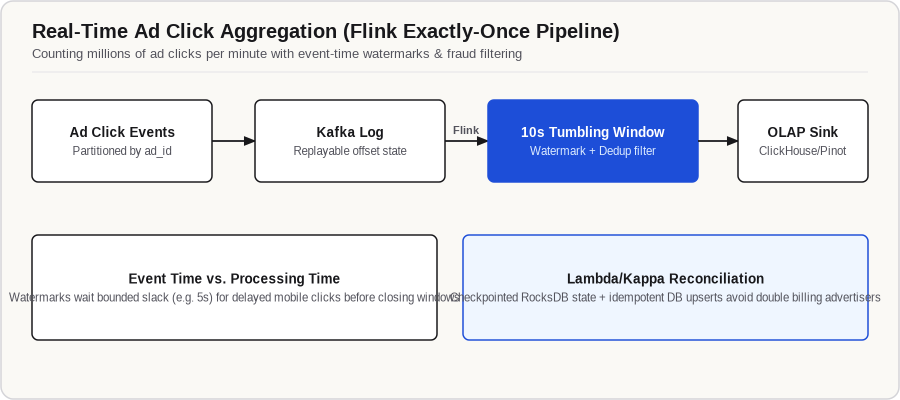
flowchart TD
    subgraph Clients["1. Ingestion Layer"]
        UserPhone["User Mobile / Web Client"] -->|"POST /v1/ad_clicks"| LB["Global Load Balancer"]
        LB --> EdgeGW["Click Tracking Ingestion Service"]
        EdgeGW --> KafkaRaw["Kafka: raw-clicks-topic (Partitioned by ad_id)"]
    end

    subgraph StreamEngine["2. Real-Time Stream Aggregation (Apache Flink / Spark)"]
        KafkaRaw --> DedupFilter{"Bot & Duplicate Filter (Redis / Bloom Filter)"}
        DedupFilter -->|"Fraud / Duplicate"| Discard["Log & Quarantine"]
        DedupFilter -->|"Valid Click"| WindowEngine["Flink Window Engine (Event-Time Watermarks)"]

        WindowEngine --> Tumbling1m["Tumbling Window 1-Minute Aggregation"]
        Tumbling1m --> CountAgg["SUM(clicks), SUM(spend), Unique Users"]
    end

    subgraph Storage["3. Real-Time OLAP & Billing"]
        CountAgg --> KafkaAgg["Kafka: aggregated-clicks-topic"]
        KafkaAgg --> OLAP[("ClickHouse / Apache Pinot (Advertiser Dashboard)")]
        KafkaAgg --> BillingDB[("Double-Entry Billing DB (PostgreSQL / Spanner)")]
    end
Real Numbers & Concurrency Sizing
Consider an ad network handling 1 Billion Ad Clicks Daily:
- Throughput Sizing:
- 1B / 86,400 ≈ 11,570 clicks/second average.
- Peak click throughput (3×): 35,000 clicks/second.
- Storage Reduction via 1-Minute Aggregation:
- Raw click event:
(click_id, ad_id, campaign_id, user_id, ip, timestamp, bid_price)≈ 200 bytes. - Raw daily storage: 1B × 200 bytes = 200 Gigabytes/day.
- If 50,000 active ad campaigns receive clicks every minute:
- 1-minute aggregation produces 50,000 × 60 × 24 = 72 million rows/day.
- Aggregated row:
(ad_id, minute_timestamp, click_count, total_cost)≈ 32 bytes. - Aggregated daily storage: 72M × 32 bytes ≈ 2.3 Gigabytes/day!
- 98.8% storage reduction while powering sub-100ms dashboard queries!
- Raw click event:
Deep Dive: Under the Hood
1. Three Types of Streaming Windows
- Tumbling Windows (Fixed, Non-Overlapping):
- Example:
[12:00 - 12:01],[12:01 - 12:02],[12:02 - 12:03]. - Every event belongs to exactly one window. Best for financial billing and hourly stats.
- Example:
- Hopping Windows (Fixed Length, Overlapping Step):
- Example: 5-minute window advancing every 1 minute (
[12:00 - 12:05],[12:01 - 12:06]). - Best for moving averages and trendline detection.
- Example: 5-minute window advancing every 1 minute (
- Sliding Windows (Dynamic Event-Driven):
- Bounded by time intervals relative to events (e.g., maximum 5 clicks from the same IP within any 10-second span).
- Best for real-time fraud and bot detection.
2. Event Time vs. Processing Time & Watermarks
- Event Time: The timestamp when the user physically tapped the screen (recorded by the mobile client).
- Processing Time: The timestamp when the stream processor (Flink) processes the event.
- The Watermark Algorithm:
- A Watermark W(t) is a declaration: "We assert that all events with Event Time ≤ t have arrived".
- To handle network delays, we set Bounded Out-of-Orderness (e.g., 5 minutes):
- When the Watermark passes
12:05:00, the[12:00 - 12:05]window closes and outputs final numbers. - Events arriving after the watermark are either processed via Side Outputs or dropped as late anomalies.
3. Click-Fraud & Bot Detection
Fraudulent networks generate fake clicks to drain competitor ad budgets.
- Deduplication Window: If the same
(user_id, ad_id)or(ip_address, ad_id)generates multiple clicks within 5 seconds, only the first click is charged; subsequent clicks are flagged as invalid clicks and discarded from billing. - IP Rate Limiting: Track clicks per IP subnet using Redis sliding window logs.
Trade-offs & Decision Matrix
| Dimension | Lambda Architecture (Batch + Stream) | Kappa Architecture (Pure Streaming - Flink) |
|---|---|---|
| Code Maintenance | Painful (must maintain dual codebases in Spark & Flink) | Elegant (single processing logic in Flink) |
| Historical Reprocessing | Easy (re-run MapReduce batch on raw files) | Requires replaying Kafka historical retention |
| Real-Time Accuracy | High (batch job corrects streaming inaccuracies nightly) | High (watermarks handle late events cleanly) |
| System Complexity | Very High | Moderate |
Common Pitfalls & Anti-Patterns
- Relying on Processing Time for Billing: If Kafka experiences an ingestion backlog, 2 hours of queued clicks will all be processed within 1 minute. Using processing time attributes 2 hours of clicks to a single 1-minute billing bucket, corrupting advertiser analytics. Always aggregate on Event Time.
- Missing Late-Event Side Outputs: Closing windows strictly and dropping late clicks causes under-counting for mobile users on intermittent transit Wi-Fi. Always configure side outputs in Flink to route late events to reconciliation tables.
- Synchronous Database Writes per Click: Writing 35,000 individual SQL inserts per second overwhelms relational databases. Ingest through Kafka, aggregate in memory with Flink, and bulk-insert minute-level summaries into ClickHouse.
Try It Yourself
A runnable, zero-dependency Python simulation demonstrating tumbling window click aggregation, event-time watermark evaluation, late-event side output handling, and bot click deduplication is included in this directory.
Run the simulation:
python demo.py
Production References & Further Reading
- Alex Xu: System Design Interview Vol 2 - Chapter 4 (Ad Click Aggregation)
- Tyler Akidau et al.: The Dataflow Model (VLDB 2015)
- Apache Flink Documentation: Timely Stream Processing & Watermarks
Top 5 Interview Questions with Model Answers
Q1: What is the difference between Event Time, Ingestion Time, and Processing Time?
Model Answer:
- Event Time: The timestamp when the action occurred on the client device (e.g., when the user tapped the ad).
- Ingestion Time: The timestamp when the message arrived at the message queue broker (e.g., when Kafka recorded the event).
- Processing Time: The local system clock of the stream processing node (e.g., Apache Flink worker) executing the aggregation code. For financial billing and business analytics, Event Time is mandatory because network lags and queue buffering introduce random delays between event occurrence and stream processing.
Q2: How do Watermarks handle late-arriving events in Apache Flink or Google Cloud Dataflow?
Model Answer: A Watermark is a monotonically increasing timestamp emitted into the stream that acts as a completion horizon: W(t) = \max(Event Time seen) - Allowed Latency Δ.
- A Watermark W(12:05) guarantees to downstream operators that no further events with timestamp ≤ 12:05 are expected to arrive.
- When W(t) passes the end of a window (e.g., 12:00), the window closes and emits its final aggregated output.
- If a late event arrives with t < W, Flink handles it using an Allowed Lateness Policy: it can either update the window via a retraction stream or divert the event to a Side Output for manual reconciliation.
Q3: How do you achieve Exactly-Once Processing in an ad click aggregation pipeline?
Model Answer: Exactly-once processing is achieved through end-to-end alignment across three pipeline stages:
- Replay-able Source: Apache Kafka retains raw click offsets.
- Stateful Stream Processing with Checkpointing (Chandy-Lamport Algorithm): Flink periodically saves consistent snapshots of aggregation state and Kafka read offsets to durable storage (S3/GCS). If a worker crashes, Flink restores state and rewinds Kafka to the last checkpoint.
- Idempotent / Transactional Sink: When writing aggregated summaries to ClickHouse or PostgreSQL, writes use Upserts on compound keys (
ad_id, window_start_time) or two-phase commit sinks (TwoPhaseCommitSinkFunction).
Q4: How do you detect and filter Click-Fraud in real time?
Model Answer: Click fraud is filtered in a multi-tier pipeline:
- Deduplication Filter (Fast Layer): When a click arrives, hash
(user_id, ad_id, ip)and check an atomic Redis key with a 5-second TTL. Duplicate clicks within 5 seconds are marked invalid and excluded from billing. - Behavioral Sliding Window (Anomaly Detection Layer): Flink maintains a sliding window tracking click velocity per IP subnet and user agent. If an IP exceeds 50 clicks/minute, subsequent clicks are routed to a fraud queue.
- Offline Machine Learning Classifier: A nightly batch job analyzes click-to-conversion rates, IP geolocation hops, and known botnet IP blacklists, issuing retroactive billing credits to advertisers for fraudulent clicks that bypassed real-time filters.
Q5: Why is ClickHouse or Apache Pinot preferred over PostgreSQL for storing aggregated ad analytics?
Model Answer:
- Columnar Storage: Aggregated analytics queries calculate aggregate functions over specific columns (
SELECT ad_id, SUM(clicks), SUM(cost) WHERE date = '2026-11-23' GROUP BY ad_id). Columnar databases only read the requested columns off disk, scanning 10× to 50× less data than row-oriented PostgreSQL. - Vectorized Query Execution: ClickHouse processes SIMD vector CPU instructions across column arrays, aggregating hundreds of millions of rows per second per core.
- Massive Compression: Columnar compression (DoubleDelta, Zstandard) achieves 5× to 10× higher compression ratios than row-based storage engines.
Check Yourself Quiz
1. Which windowing strategy produces non-overlapping, fixed-duration time buckets?
A) Sliding WindowB) Tumbling Window
C) Session Window
D) Hopping Window
Answer: B. Tumbling windows have fixed size and zero overlap (e.g. 12:00-12:01, 12:01-12:02).
2. Why is Event Time preferred over Processing Time for calculating advertiser ad charges?
A) Because Processing Time cannot be stored in Kafka.B) Because network delays and queue buffering would incorrectly shift clicks to later minutes, distorting billing attribution.
C) Because Event Time is always in UTC.
D) Because Processing Time requires GPS.
Answer: B. Event Time represents the true moment of user engagement, independent of network transit delays.
3. What does a Watermark timestamp W(t) signify to a stream processing operator?
A) That the database is full.B) That no further events with timestamp earlier than t are expected to arrive, triggering window completion.
C) That the server should reboot.
D) That the user clicked twice.
Answer: B. Watermarks provide a temporal progress indicator that allows windows to close and emit results.
4. How does 1-minute click aggregation reduce database storage costs?
A) By deleting all ad clicks after 1 hour.B) By combining thousands of raw click events for an ad into a single summary row per minute, achieving 95%+ storage reduction.
C) By compressing data with MP3.
D) By disabling SQL indexes.
Answer: B. Summarizing thousands of clicks into periodic count/sum rows drastically shrinks data footprint.
5. Which database type is best suited for real-time advertiser analytics dashboards?
A) Relational Row Store (PostgreSQL / MySQL)B) Distributed Columnar OLAP Store (ClickHouse / Apache Pinot)
C) Redis String Key-Value
D) MongoDB Document Store
Answer: B. Columnar OLAP stores provide sub-second aggregations (`SUM`, `AVG`, `GROUP BY`) across billions of rows.